Harvey Performance Company
  • About Us
    • Company Overview
    • Our Unique Strengths
    • Our Partners
    • Our History
    • Our Locations
    • Sustainability
    • Giving Back
      • Giving Back
      • One Tree Planted
    • News
      • News
      • Press
  • Our Brands
    • Harvey Tool
    • Helical Solutions
    • Micro 100
    • Titan USA
    • CoreHog
    • Valor Holemaking
    • ATA Air Tools
    • ATA SGSPRO
    • Garryson
    • Industrial Tooling Corporation (ITC)
    • Karnasch
    • Van Hoorn Carbide
  • Products
    • Milling
    • Drilling
    • Grinding
    • Micro Tools
    • Sinking
    • Sawing
    • Composite Tools
    • Threading
    • Turning
    • Beveling
    • Reaming
    • Air Tools
  • Solutions
    • Aerospace
    • Automotive
    • Defense
    • Energy
    • Foundries
    • Marine
    • Medical
    • Mold & Die
    • Oil & Gas
    • Power Generation
    • Rail
  • Resources
    • CAM & TDM Tool Libraries
    • Machining Advisor Pro
    • In the Loupe Blog
    • Webinars
  • Careers
  • Contact Us
  • Menu Menu
  • Link to LinkedIn
  • Link to Facebook

An Introduction to Reamers & CNC Reaming

June 10, 2019/3 Comments/in Drilling & Holemaking, Harvey Tool, Machining Techniques, Tool Information Guides, Tool Selection/by Harvey Performance Company

Most machinists are familiar with CNC drilling, but did you know that the common practice for holemaking is to always use a reamer? When done correctly, reaming can be a fast and highly accurate operation that results in precision holes.

Critical Reamer Geometries
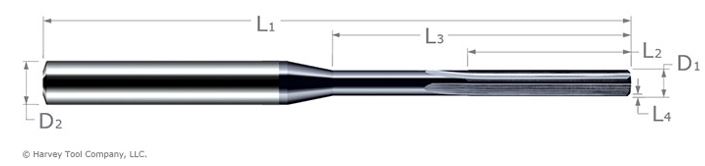
harvey tool miniature straight flute reamer with dimension callouts
Harvey Tool Miniature Reamer

By examining a Harvey Tool Miniature Reamer and its critical dimensions, we can better understand the functionality of this useful tool. In the above image of a straight flute reamer, D1 references the reamer diameter, the specific size intended for your hole; and D2 points to the shank diameter. At Harvey Tool, reamer shanks are oversized to help maintain tool strength, stiffness, and accuracy. Shanks also have an h6 tolerance, which is crucial for high precision tool holders, such as heat shrink collets. Other critical dimensions of a reamer include its overall length (L1), margin length (L2), overall reach (L3), and chamfer length (L4).

Harvey Tool also offers Miniature Reamers – Right Hand Spiral. This tool is designed to leave a superior part finish and help with chip evacuation in blind hole applications.
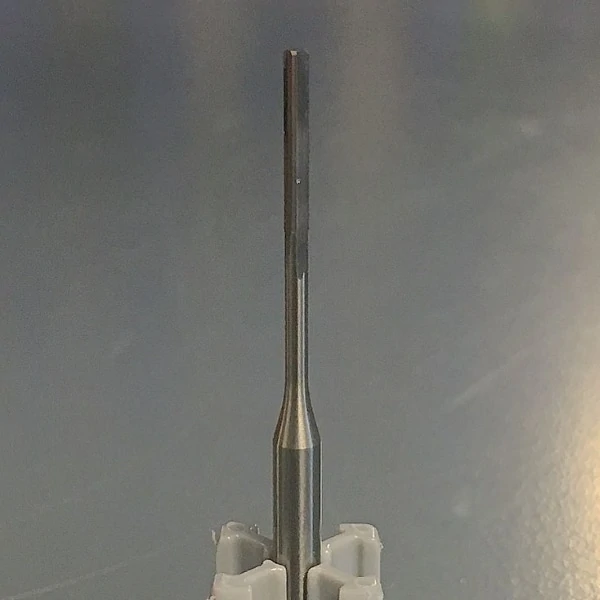
straight flute miniature reamer

The Functions of Miniature Reamers

Reamers Provide Precision – As mentioned earlier, reamers are great for machining precision hole diameters. To use a reamer properly, you must first have a pre-drilled hole that’s between 90% and 94% of the final hole diameter. For example, if you need a finished a hole of .220″, your predrilled hole should be somewhere between .1980″ and .2068″. This allows the tool to take enough material off to leave a great finish, but does not overwork it, potentially causing damage. The tolerance for uncoated reamers is +.0000″/-.0002″, while the tolerance for AlTiN coating is +.0002″/-.0000″. These tolerances provide you the peace of mind of knowing that your hole will meet exact specifications.

Achieve a Quality CNC Finish – When a high surface finish is required of a hole, reamers should always be used to reach the desired tolerance. Both the pre-drilled hole and the tool’s margin help to keep the reamer centered while cutting, leading to a better finish.
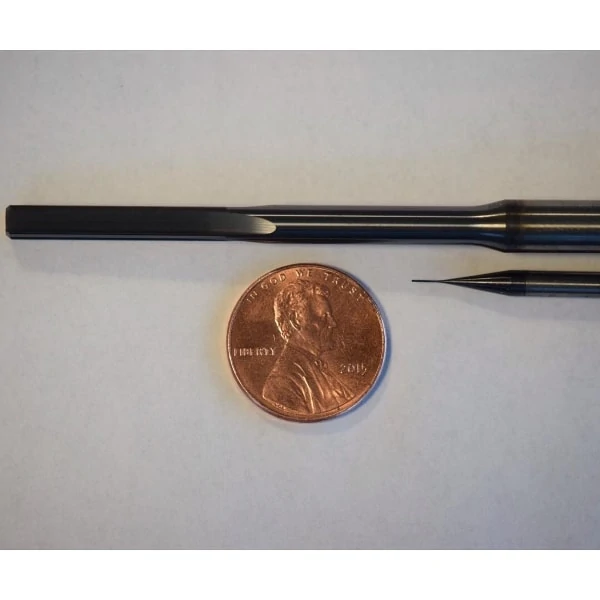
miniature reamer and end mill next to a penny

Minimize Machining Production Runs – For machine shops, consistency is a priority. This is especially true in production runs. The last thing a machinist wants to see is an oversized hole on a part they have already preformed many operations on. Remember, reamers have the benefit of offering consistent hole size, preventing an out of tolerance finish. These consistent holes lead to valuable time savings and reduced scrap costs.

CNC Machining Exotic Alloys: When machining Inconel, titanium, and other high-cost materials, reaming your hole is important to ensure that the desired finish specification is met. With reamers, a machinists can better predict tool life, leading to a better finished product and less scrap ratios. It is important to note that Harvey Tool reamers are offered AlTiN coated and fully stocked in every .0005” increment from .0080” to .0640”.


https://www.harveyperformance.com/wp-content/uploads/2019/06/Feature-Image-Intro-to-Reamers-IMG.jpg 525 1400 Harvey Performance Company http://www.harveyperformance.com/wp-content/uploads/2018/08/Logo_HarveyPerformanceCompany-4.png Harvey Performance Company2019-06-10 10:57:532023-10-24 10:51:30An Introduction to Reamers & CNC Reaming

Confidently Select Your Next Thread Mill

January 10, 2019/0 Comments/in Drilling & Holemaking, Harvey Tool, Machining Techniques, Thread Milling, Tool Information Guides, Tool Selection/by Ben Holm

Do you know the key differences between a Single Form Thread Mill and a Multi-Form version? Do you know which tooling option is best for your job? This blog post examines how several factors, including the tool’s form and max depth of thread, are important to ultimately making the appropriate Harvey Tool decision.

Thread Mill Product Offering

Single Form

The single form thread mill is the most versatile threading solution Harvey Tool offers. These tools are ground to a sharp point and are capable of milling 60° thread styles, such as UN, metric, and NPT threads. With over 14 UN and 10 Metric sized tools, Harvey Tool’s single form selections allow machinists the opportunity to machine many different types of threads.

single form harvey tool thread mill

Harvey Performance Company, LLC.

Single Form Thread Mills for Hardened Steels

Similar to the standard single form, Harvey Tool’s thread mills for hardened steels offer machinists a quality option when dealing with hardened steels from 46-68 Rc. The following unique geometries helps this tool machine tough alloys:

  1. Ground Flat – Instead of a sharp point these tools have a ground flat to help ensure long tool life.
  2. Eccentric Relief – Gives the cutting edges extra strength for the high feeds at relatively low RPMs required for harder materials.
  3. AlTiN Nano Coating – Allows for superior heat resistance.

single form thread mill for hardened steels

Harvey Performance Company, LLC.

A key difference between the standard Single Form and the Single Form for Hardened Steels is that the tools for hardened steels are actually only capable of milling 83% of the actual thread depth. At first, this may seem detrimental to your operation. However, according to the Machinery’s Handbook 29th Edition, “Tests have shown that any increase in the percentage of full thread over 60% does not significantly increase the strength of the thread. Often, a 55% to 60% thread is satisfactory, although 75% threads are commonly used to provide an extra margin of safety.” With the ability to preserve tool life and effectively perform thread components, Harvey Tool’s single form thread mills for hardened steels are a natural choice when tackling a hardened material.

Tri-Form

Tri-Forms are designed for difficult-to-machine materials. The tri-form design reduces tool pressure and deflection, which results in more accurate threading. Its left-hand cut, left-hand spiral design allows it to climb mill from the top of the thread to the bottom.

tri form thread mill from harvey tool

Harvey Performance Company, LLC.

Multi-Form

Our multi-form thread mills are offered in styles such as UN, NPT, and Metric. Multi-Form tools are optimized to produce a full thread in single helical interpolation. Additionally, they allow a machinist to quickly turn around production-style jobs.

multi-form thread mill

Harvey Performance Company, LLC.

Coolant-Through Multi Form Thread Mills

Coolant-Through Multi Form Thread Mills are the perfect tool for when a job calls for thread milling in a blind hole. The coolant through ability of the tool produces superior chip evacuation. These tools also improve coolant flow to the workpiece – delivering it directly from the tip of the tool – for decreased friction and high cutting speeds.

coolant through multi form thread mill

Harvey Performance Company, LLC.

Long Flute

These tools are great when a job calls for a deep thread, due to their long flute. Long Flutes also have a large cutter diameter and core, which provides the tool with improved tool strength and stability.

long flute harvey tool thread mill

Harvey Performance Company, LLC.

N.P.T. Multi-Form

While it may seem obvious, N.P.T. Multi-Form Thread Mills are perfect for milling NPT threads. NPT threads are great for when a part requires a full seal, different from traditional threads that hold pieces together without the water-tight seal.

npt thread mill from harvey tool

Harvey Performance Company, LLC.

https://www.harveyperformance.com/wp-content/uploads/2019/01/Feature-Image-Selecting-Thread-Mill-IMG.jpg 525 1400 Ben Holm http://www.harveyperformance.com/wp-content/uploads/2018/08/Logo_HarveyPerformanceCompany-4.png Ben Holm2019-01-10 01:44:532024-04-30 09:42:20Confidently Select Your Next Thread Mill

Selecting the Right Harvey Tool Miniature Drill

April 19, 2018/0 Comments/in Drilling, Drilling & Holemaking, Harvey Tool, Holemaking, Tool Geometry, Tool Information Guides, Tool Selection/by Harvey Performance Company

Among Harvey Tool’s expansive holemaking solutions product offering are several different types of miniature drill options and their complements. Options range from Miniature Spotting Drills to Miniature High Performance Drills – Deep Hole – Coolant Through. But which tools are appropriate for the hole you aim to leave in your part? Which tool might your current carousel be missing, leaving efficiency and performance behind? Understanding how to properly fill your tool repertoire for your desired holemaking result is the first step toward achieving success.

Pre-Drilling Considerations

Miniature Spotting Drills

Depending on the depth of your desired machined hole and its tolerance mandates, as well as the surface of the machine you will be drilling, opting first for a Miniature Spotting Drill might be beneficial. This tool pinpoints the exact location of a hole to prevent common deep-hole drilling mishaps such as walking, or straying from a desired path. It can also help to promote accuracy in instances where there is an uneven part surface for first contact. Some machinists even use Spotting Drills to leave a chamfer on the top of a pre-drilled hole. For extremely irregular surfaces, however, such as the side of a cylinder or an inclined plane, a Flat Bottom Drill or Flat Bottom Counterbore may be needed to lessen these irregularities prior to the drilling process.

harvey tool miniature spotting drill with dimension callout marks

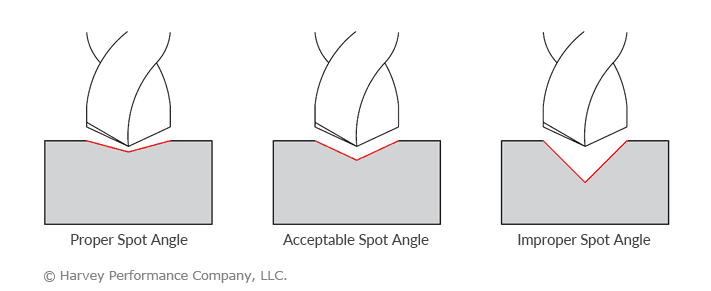
Tech Tip: When spotting a hole, the spot angle should be equal to or wider than the angle of your chosen miniature drill. Simply, the miniature drill tip should contact the part before its flute face does.

infographic showcasing proper spot angle for spot drilling in relation to drills included angle

Selecting the Right Miniature Drill

Harvey Tool stocks several different types of miniature drills, but which option is right for you, and how does each drill differ in geometry and overall tool coating?

Miniature Drills

Harvey Tool Miniature Drills are popular for machinists seeking flexibility and versatility with their holemaking operation. Because this line of tooling is offered uncoated in sizes as small as .002” in diameter, machinists no longer need to compromise on precision to reach very micro sizes. Also, this line of tooling is designed for use in several different materials where specificity is not required.

harvey tool extended depth miniature drill

Miniature High Performance Drills – Deep Hole – Coolant Through

For situations in which chip evacuation may be difficult due to the drill depth, Harvey Tool’s Deep Hole – Coolant Through Miniature Drills might be your best option. The coolant delivery from the drill tip will help to flush chips from within a hole, and prevent heeling on the hole’s sides, even at depths up to 20 multiples of the drill diameter.

harvey tool miniature deep hole coolant through gun drill

Miniature High Performance Drills – Flat Bottom

Choose Miniature High Performance Flat Bottom Drills when drilling on inclined and rounded surfaces, or when aiming to leave a flat bottom on your hole. Also, when drilling intersecting holes, half holes, shoulders, or thin plates, its flat bottom tool geometry helps to promote accuracy and a clean finish.

harvey tool miniature flat bottom drill with dimension callouts

Miniature High Performance Drills – Aluminum Alloys

The line of High Performance Drills for Aluminum Alloys feature TiB2 coating, which has an extremely low affinity to Aluminum and thus will fend off built-up edge. Its special 3 flute design allows for maximum chip flow, hole accuracy, finish, and elevated speeds and feeds parameters in this easy-to-machine material.

miniature drill for aluminum from harvey tool with dimension callouts

Miniature High Performance Drills – Hardened Steels

Miniature High Performance Drills – Hardened Steels features a specialized flute shape for improved chip evacuation and maximum rigidity. Additionally, each drill is coated in AlTiN Nano coating for hardness, and heat resistance in materials 48 Rc to 68 Rc.

miniature drill for hardened steel with dimension callouts

Miniature High Performance Drills – Prehardened Steels

As temperatures rise during machining, the AlTiN coating featured on Harvey Tool’s Miniature High Performance Drills – Prehardened Steels creates an aluminum oxide layer which helps to reduce thermal conductivity of the tool and helps to promote heat transfer to the chip, as well as improve lubricity and heat resistance in ferrous materials.

miniature drill for prehardened steel with dimension callouts

Post-Drilling Considerations

Miniature Reamers

For many operations, drilling the actual hole is only the beginning of the job. Some parts may require an ultra-tight tolerance, for which a Miniature Reamer (tolerances of +.0000″/-.0002″ for uncoated and +.0002″/-.0000″ for AlTiN Coated) can be used to bring a hole to size. harvey tool straight flute miniature reamer with dimension callouts

Tech Tip: In order to maintain appropriate stock removal amounts based on the reamer size, a hole should be pre-drilled at a diameter that is 90-94 percent of the finished reamed hole diameter.

Flat Bottom Counterbores

Other operations may require a hole with a flat bottom to allow for a superior connection with another part. Flat Bottom Counterbores leave a flat profile and straighten misaligned holes. For more information on why to use a Flat Bottom Counterbore, read 10 Reasons to Use Flat Bottom Tools.

harvey tool flat bottom counterbores with dimension callouts

Key Next Steps

Now that you’re familiar with miniature drills and complementary holemaking tooling, you must now learn key ways to go about the job. Understanding the importance of pecking cycles, and using the correct approach, is vital for both the life of your tool and the end result on your part. Read this post’s complement “Choosing the Right Pecking Cycle Approach,” for more information on the approach that’s best for your application.

https://www.harveyperformance.com/wp-content/uploads/2018/04/Featured-Image-Miniature-Drill-IMG.jpg 525 1400 Harvey Performance Company http://www.harveyperformance.com/wp-content/uploads/2018/08/Logo_HarveyPerformanceCompany-4.png Harvey Performance Company2018-04-19 08:00:482024-11-07 16:28:32Selecting the Right Harvey Tool Miniature Drill

10 Reasons to Use Flat Bottom Tools

January 23, 2018/13 Comments/in Drilling, Drilling & Holemaking, Harvey Tool, Holemaking, Machining 101, Tool Geometry, Tool Information Guides, Tool Selection/by Harvey Performance Company

Flat bottom tools, or tools with flat bottom geometry, are useful in a variety of situations and operations that tools with typical cutting geometry are not. The standard characteristics of drills or end mills are useful for their primary functions, but make them unsuitable for certain purposes. When used correctly, the following flat bottom tools can make the difference between botched jobs and perfect parts.

Flat Bottom Drills

Flat Bottom Drill

Flat bottom drills are perfect for tricky drilling situations or for creating flat bottom holes without secondary finishing passes. Consider using these specialized drills for the operations below.

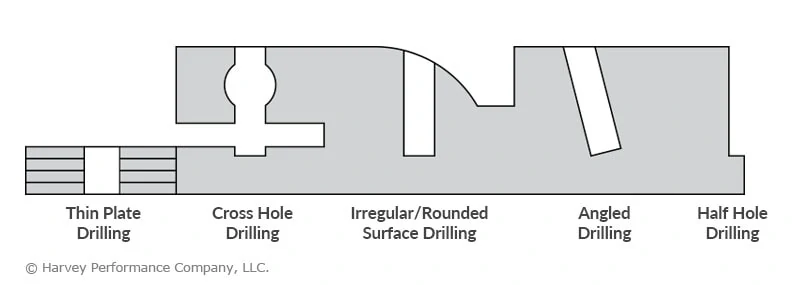
infographic showing 5 different Flat Bottom Drill Operations

Thin Plate Drilling

When drilling through holes in thin plates, pointed drills are likely to push some material out the exit hole and create underside burrs. Flat bottom drills are significantly less likely to experience this problem, as their flat bottom geometry generates more even downward forces.

Crosshole Drilling

When drilling a hole that crosses the path of another hole, it is important to avoid creating burrs, since they can be extremely difficult to remove in this kind of cross section. Unlike drills with points, flat bottom drills are designed to not create burrs on the other side of through holes.

Irregular/Rounded Surface Drilling

Flat bottom drills initially engage irregular surfaces with their outer edge. Compared to making first contact with a standard drill point, this makes them less susceptible to deflection or “walking” on inclined surfaces, and more capable of drilling straighter holes.

Angled Drilling

Even if the surface of a part is flat or regular, a pointed drill is susceptible to walking if it engages the part at an angle, known as angled or tilted drilling. For the same reason flat bottom drills are ideal for drilling on irregular surfaces, they are perfect for angled drilling.

Half Hole Drilling

When drilling a half hole on the edge of a part, the lack of material on either side of the drill makes the operation unstable In this situation, a pointed drill is susceptible to walking. A flat bottom drill makes contact with its entire cutting geometry, allowing for more versatility and stability when drilling half holes.

Flat Bottom Counterbores

Flat Bottom Counterbore

Flat bottom counterbores are an excellent choice when a flat bottom hole is needed and a tool without flat bottom geometry was used to create it. Keep some of these tools on hand to be prepared for the operations below.

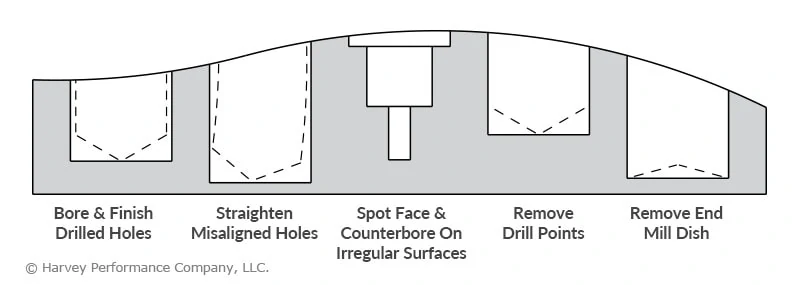
infographic showcasing 5 different uses of flat bottom counterbores

Bore & Finish Drilled Holes

Drill geometry is designed first and foremost for factors like stability, rigidity, and chip evacuation. Some holes will need secondary finishing operations. Flat bottom counterbores are often designed with a slow helix and low rake, which help them avoid part engagement and control finish.

Straighten Misaligned Holes

Even experienced machinists may drill a less-than-perfectly-straight hole or two in new and unfamiliar jobs. Fortunately, flat bottom counterbores are well-suited for straightening misaligned holes.

Spot Face & Counterbore on Irregular Surfaces

The unique geometry of flat bottom counterbores makes them  effective at spotting on irregular surfaces. Standard drills and spot drills are susceptible to walking on these kinds of surfaces, which can potentially ruin an operation.

Remove Drill Points

When a standard drill creates a hole (other than a through hole) it leaves a “drill point” at the bottom due to its pointed geometry. This is fine for some holes, but holes in need of a flat bottom will need a secondary operation from a flat bottom counterbore to remove the drill point.

Remove End Mill Dish

The dish angle present on most standard end mills allows proper end cutting characteristics and reduces full diameter contact. However, these end mills will naturally leave a small dish at the bottom of a hole created by a plunging operation. As with drill points, flat bottom counterbores are perfect to even out the bottom of a hole.

https://www.harveyperformance.com/wp-content/uploads/2018/01/Feature-Image-10-Reasons-Flat-Bottom-IMG.jpg 525 1400 Harvey Performance Company http://www.harveyperformance.com/wp-content/uploads/2018/08/Logo_HarveyPerformanceCompany-4.png Harvey Performance Company2018-01-23 09:54:442024-02-12 14:17:1810 Reasons to Use Flat Bottom Tools

Overcoming Composite Holemaking Challenges

April 21, 2017/0 Comments/in CNC Machining, Composites, Drilling & Holemaking, Holemaking, Machining Techniques, Material Specific, Milling, Tool Selection/by Harvey Performance Company

Harvey Tool’s Miniature High Performance Composite Drills are specifically designed with point geometry optimized for the unique properties of composite materials. Our Double Angle style is engineered to overcome common problems in layered composites and our Brad Point style is built to avoid the issues frequently experienced in fibrous composites.

Common Composite Problems

Drilling in composite materials is a unique challenge. There are a wide variety of regularly machined composites, each requiring different considerations and approaches. Overcome common composite holemaking problems by identifying and selecting the right tool for your job.

Delamination

Defining Delamination

Delamination occurs when high drilling forces cause laminated layers to separate, yielding less structurally-sound parts. The more blunt a drill point is, the more force it will take to move through a part, increasing the chance of delamination.

Delamination and Push-Out

Identifying Delamination

The separation of layers may be difficult to identify through visible scrutiny. Closely inspecting and testing the hole quality is ideal when looking for delamination.

Ideal Drill Choice

Double Angle Composite Drills

Uncut Fibers

Defining Uncut Fibers

Uncut fibers are largely caused by dull tooling. If a drill’s cutting edge is not sharp enough, fibers will remain uncut, frayed, or splintered, potentially ruining the part.

Identifying Uncut Fibers

Uncut fibers should be easily noticed: look for splintered or frayed fibers around the edges of your hole.

Ideal Drill Choice

Brad Point Composite Drills

Tear-Out

Defining Tear-Out

Rather than leaving uncut fibers hanging on to a workpiece, dull tools can also grab fibers and tear them out of the material altogether. This can leave voids in your material and cause damage to even greater areas of the workpiece.

Tear Out

Identifying Tear-Out

Tear-out can be more difficult to spot than uncut fibers. However, it is often seen as an area of material completely removed around the edge of a hole.

Ideal Drill Choice

Brad Point Composite Drills

Choose Your Tool

Harvey Tool’s new Composite Drills are engineered with point geometry optimized for fibrous and layered composite materials. Each design is specifically built to overcome common composite drilling challenges and achieve excellent results.

Double Angle Composite Drills

Avoid Delamination and Push-Out

composite drills Harvey

v

Harvey Tool’s Double Angle Composite Drills help combat delamination and push-out in layered composite materials with specialized point geometry. The primary 130° point angle allows the drill to efficiently engage laminated composites without lifting the top layer of material. The shallower secondary 60° point angle reduces the amount of force required to move the drill through the material, further reducing the probability of delamination. The higher shear angle also aids in reducing push-out at the back of the workpiece by more gradually breaking through the part.

Brad Point Composite Drills

Avoid Uncut Fibers and Tear Out

composite drills

Harvey Tool’s Brad Point Composite Drills are designed specifically for superior performance in fibrous materials. The trident-like brad point ensures that holes in fiber filled and reinforced materials come out clear and free of fraying. The outer points accurately score the outer diameter of drilled holes, eliminating uncut fibers, tear-out, and splintering.

For more information on Composite Drills and all of Harvey Tool’s new products, visit the Harvey Tool website.

https://www.harveyperformance.com/wp-content/uploads/2017/04/Feature-Image-Composite-Holemaking-Challenges.jpg 525 1401 Harvey Performance Company http://www.harveyperformance.com/wp-content/uploads/2018/08/Logo_HarveyPerformanceCompany-4.png Harvey Performance Company2017-04-21 10:00:312024-11-06 13:16:28Overcoming Composite Holemaking Challenges
Page 2 of 212
BLOG HOME

Search In the Loupe

More results...

Browse by Topic

How-To’s
Technical Tips
Tools In Action
Featured Customers
Tool Guides

Free Drilling Guidebook

DOWNLOAD

Recent Posts

  • Machining a Complex Part with Harvey Tool
  • Drill Substrate Guide: HSS vs Cobalt vs Carbide
  • The Key Differences Between Helical’s Tool Coatings

Stay In The Loupe!

Sign up to receive a monthly recap of:
– The latest machining solutions
– Machining tips and tricks
– A recap of our most popular posts

SIGN UP

Contact Us


Address
428 Newburyport Turnpike
Rowley, MA 01969

Website
www.harveyperformance.com

Phone
Harvey Tool Tech: 1.800.645.5609
Helical Solutions Tech: 1.866.543.5422
Micro 100 Tech: 1.800.421.8065
Titan USA Tech: 1.888.482.6872

Email
[email protected]
[email protected]
[email protected]
[email protected]
[email protected]

CONTACT US

428 Newburyport Turnpike
Rowley, MA 01969-1729

844-393-8665

[email protected]

HARVEY PERFORMANCE

Company Overview
Our Unique Strengths
Industries Served
Careers
Sustainability
Privacy Policy

OUR BRANDS

Harvey Tool
Helical Solutions
Micro 100
Titan USA
CoreHog
Valor Holemaking

OUR BRANDS

ATA Air Tools
ATA SGSPRO
Garryson
Industrial Tooling Corporation (ITC)
Karnasch
Van Hoorn Carbide

Copyright © 2022 Harvey Performance Company, LLC
  • Link to LinkedIn
  • Link to Facebook
Scroll to top Scroll to top Scroll to top